
Barna wanted to know something simple: if you call a church during business hours, does anyone pick up?
So they called. Thousands of churches, during office hours, the way a visitor or a member would. More than half the time, nobody answered.
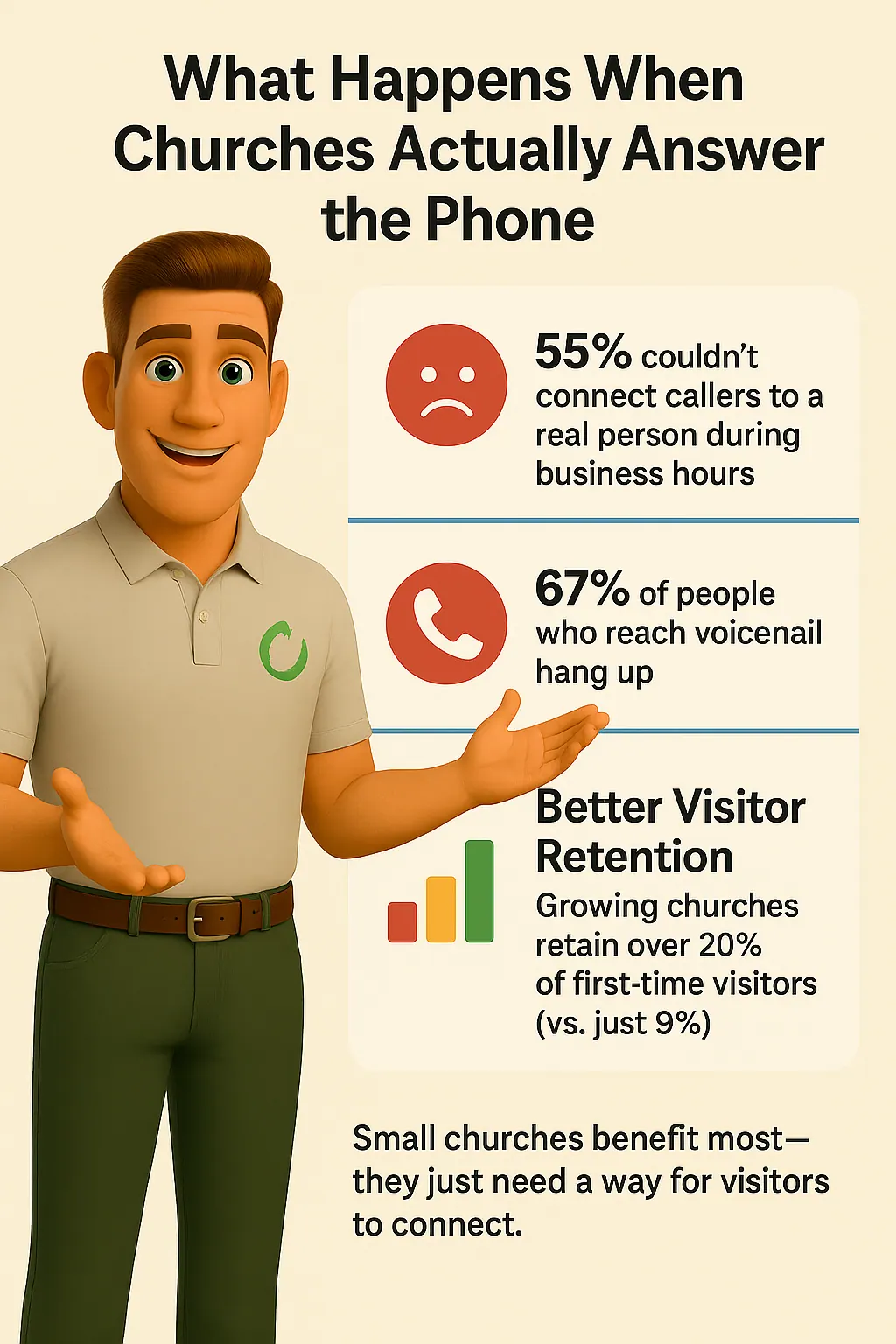
55% of churches couldn't connect the caller with a person. Not at night, not on a holiday. During regular office hours.
That number isn't a judgement. Most of those churches have one person running the office part time and a pastor who's out visiting people, which is exactly where a pastor should be. The phone rings during all of it.
But it's worth knowing what's on the other side of that call.
 Every missed call is someone who wanted to reach your church.
Who's calling
Think about the last ten calls your church got. They probably looked something like this:
- Someone new asking what time Sunday service starts and whether there's something for their kids.
- A member whose father just went into the hospital.
- A family asking about a funeral, a wedding, or a baptism.
- Someone who needs food or help with a bill this week.
- A vendor or a sales call.
Only one of those can wait. The rest are people at a turning point, and most of them won't try twice.
67% of people hang up when they can't reach someone at the church. Most never leave a message. You don't get a missed call you can return. You get nothing, and you never find out it happened.
What changes when someone answers
First-time guests come back
Growing churches keep about 20% of their first-time visitors. Churches that aren't growing keep about 9%. That gap is mostly follow-up: whether a guest's questions get answered and whether someone reaches back out.
For a lot of guests, the first question comes before the first visit, and it comes by phone. "What time is service?" "Is there parking?" "What do I do with my kids?" A church that answers those calls has already welcomed the guest before Sunday.
The hard calls reach a person
A phone that gets answered means the person calling about a hospital stay, a death in the family, or a crisis reaches someone who can help, or gets passed straight to the pastor. Those are the calls that matter most, and they're the ones voicemail handles worst.
Your team gets their time back
Answering every call doesn't mean your office manager has to sit by the phone. The routine questions (service times, directions, office hours, events) can be answered without anyone stopping what they're doing. The calls that need a person still reach one.
People trust the church that picks up
Everyone has spent an afternoon trying to reach a business that never answers. People draw conclusions from it. A church that picks up comes across as open and present before anyone walks through the door.
Small churches feel this most
A church of a few thousand people has a receptionist. A church of seventy has a pastor with six jobs and maybe a volunteer on Tuesday mornings.
That's why missed calls hurt small churches most. Each first-time guest matters more, and there's less staff to catch the call. It's also why a small change makes such a difference for them.
What it takes
Answering every call is a schedule more than a budget. There are a few ways churches get there:
- A volunteer rota. Works when you have the people, and is hard to keep up for evenings and weekends.
- Forwarding to a staff cell phone. Reliable for emergencies, and it means someone is never quite off duty.
- An answering service. Traditional services bill by the minute. AI phone agents like ChurchCalls.ai answer every call for a flat monthly price, handle the routine questions, take messages, and send urgent calls to the right person on your team.
Most churches end up using a mix: people when they're available, and help covering the hours they aren't. We wrote more about that in how to use both humans and AI to support ministry.
Try this tomorrow
Call your church from a phone the office won't recognize, on a weekday afternoon. Then call again on Saturday evening.
If someone answers both times, you're in the 45%. If you hit voicemail, or nothing at all, you've just found the easiest win your church has this year.
If you'd like to hear how an answered call sounds, you can have our agent call you. It takes about a minute.